 DNAtest
Minoans and Mycenaeans: Greek DNA from the Bronze Age
DNAtest360 earns a commission if you buy through links on this page.
Four thousand years ago, on the island of Crete, young acrobats somersaulted over charging bulls in the courtyards of painted palaces. A few centuries later, on the Greek mainland, warrior kings were laid in their graves with faces covered in beaten gold. These were the Minoans and the Mycenaeans, Europe's first great palace civilizations and the world that later Greeks remembered as the age of heroes. For over a century archaeologists argued about where they came from. Ancient DNA has now given a clear answer, and it reaches all the way to people living in Greece today.
In short
- The Minoans built palace towns on Crete from about 1900 BCE. The Mycenaeans ruled fortified palaces on mainland Greece from about 1600 BCE and wrote the earliest known Greek.
- Genetically the two were very similar: at least three-quarters of their ancestry came from the first Neolithic farmers of Anatolia and the Aegean, and most of the rest from peoples related to those of the Caucasus and Iran.
- The big difference: Mycenaeans also carried some ancestry linked to the Eurasian steppe, which Minoans mostly lacked. It had reached northern Greece by about 2000 BCE.
- The old idea that the Minoans came from North Africa has been ruled out by DNA. And modern Greeks resemble the Mycenaeans closely, with some later additions.
The Minoans: palace-builders of Crete
The name "Minoan" is modern. The British archaeologist Arthur Evans, who began excavating Knossos in 1900, borrowed it from King Minos of Greek legend, the ruler whose labyrinth hid the Minotaur. What the Minoans called themselves we don't know. Egyptian records may refer to them as the Keftiu, and Egyptian tomb paintings show foreign envoys bearing Aegean-style gifts.
From about 1900 BCE, great palace complexes rose at Knossos, Phaistos, Malia and Zakros. They were less royal castles than busy centres: courtyards, storerooms full of giant jars of oil and grain, workshops, shrines and drains that still impress engineers. The Minoans traded across the eastern Mediterranean, with Egypt, Cyprus and the Levant, and their influence spread over the southern Aegean islands. In 2025, six Minoan palatial centres were added to UNESCO's World Heritage List.
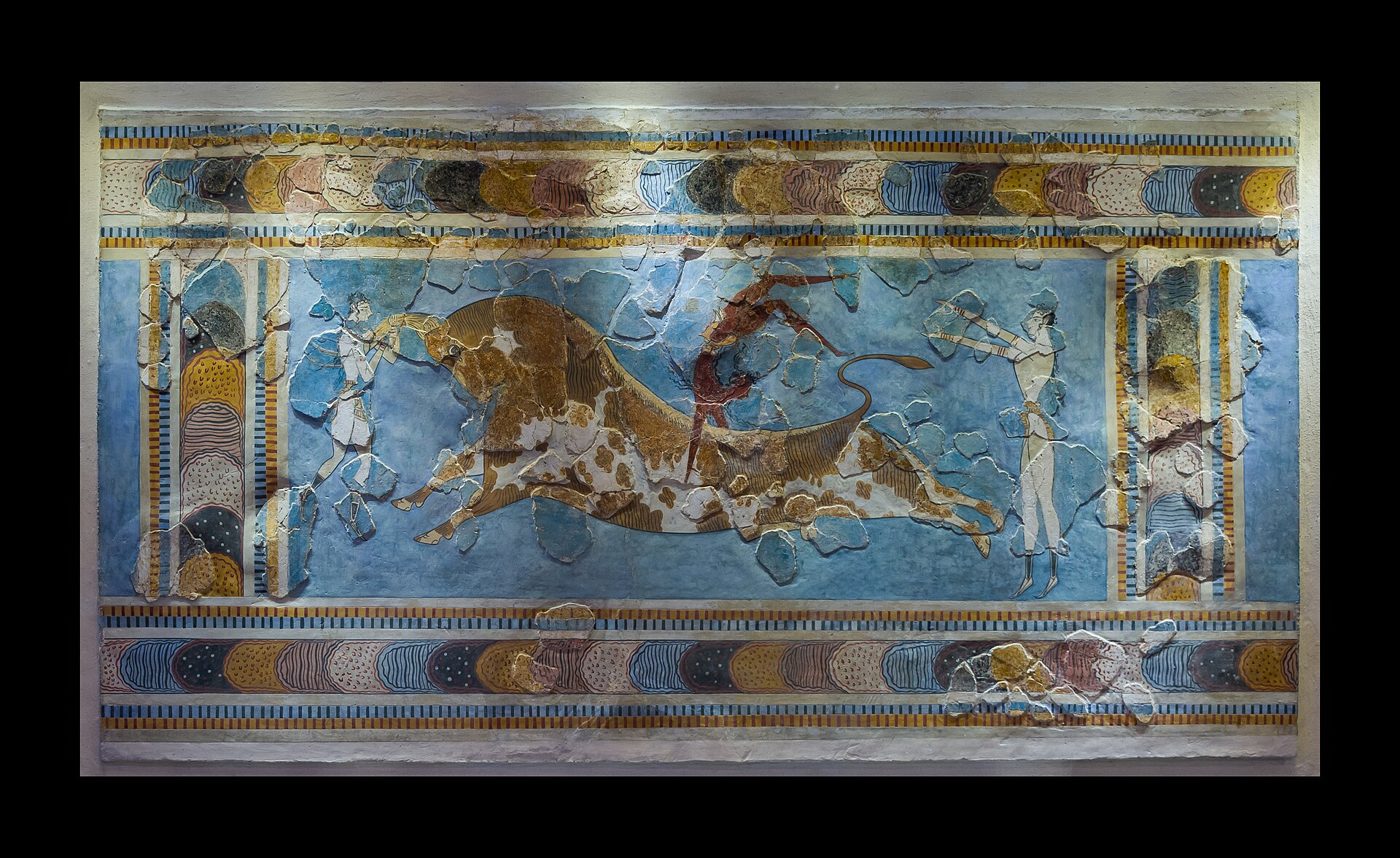
Their art is full of life: dolphins, lilies, octopuses, processions and the famous bull-leapers. They wrote in two scripts, Cretan hieroglyphs and Linear A, and neither has been deciphered, so their language is still a mystery. Around the 17th or 16th century BCE (the exact date is debated), a huge volcanic eruption on Thera, today's Santorini, buried the Minoan-style town of Akrotiri in ash. By about 1450 BCE many Cretan sites had been destroyed, and Greek-speaking Mycenaeans were in charge at Knossos.
The Mycenaeans: Homer's heroes, in real life
Around 1600 BCE, rich warrior graves appeared at Mycenae in the Peloponnese. When Heinrich Schliemann opened the Shaft Graves in 1876, he found gold masks, swords and jewellery. He believed one mask showed Agamemnon, the king who led the Greeks to Troy in Homer's Iliad. In fact it is centuries older than any Trojan War could have been, but the name stuck.
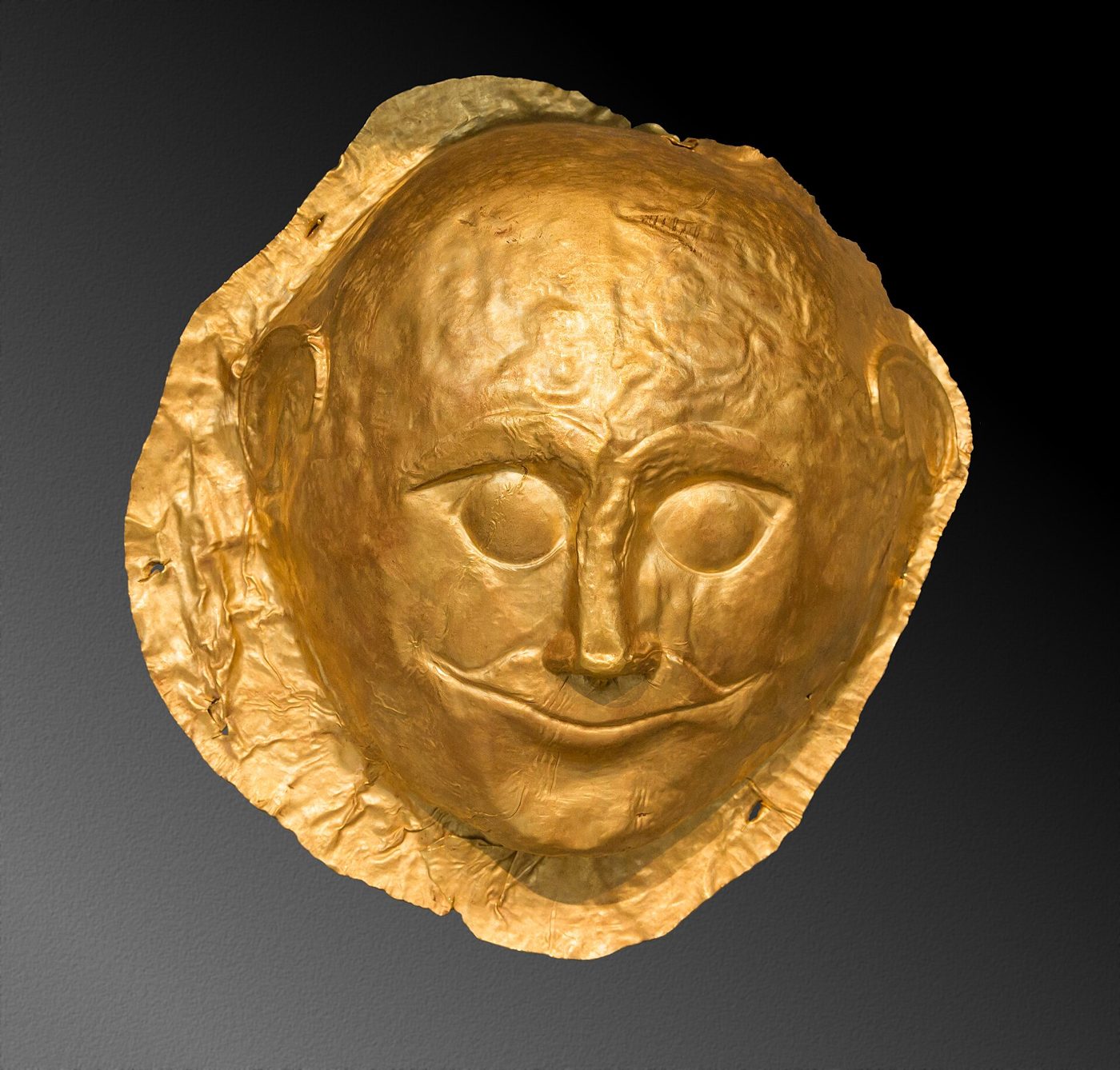
Over the next centuries, palaces rose at Mycenae, Tiryns, Pylos and Thebes. Their walls were built of stones so enormous that later Greeks thought giants, the Cyclopes, must have placed them. Near the palace of Pylos, archaeologists in 2015 found the untouched grave of a man now called the Griffin Warrior, buried around 1450 BCE with weapons, gold rings and objects in Minoan style, a sign of how closely the two worlds had become entwined.
The Mycenaeans adapted the Minoan script to write their own language. The result, Linear B, was deciphered by Michael Ventris in 1952, and it proved the Mycenaeans spoke an early form of Greek. Their clay tablets list grain, wool, perfumed oil and livestock, and name gods later Greeks still worshipped, including Zeus, Hera and Poseidon. Around 1200 BCE the palaces were destroyed or abandoned amid the wider Late Bronze Age collapse. The causes are still debated, but the memory of this age lived on in the epics of Homer.
Where did they come from? The question DNA settled
Evans thought the Minoans might have come from North Africa. Others suggested the Balkans, Anatolia or the Levant. Some argued the Mycenaeans were newcomers who swept in from the north. For a century, pots and palaces couldn't settle it.
The first DNA answer came in 2013, when Hughey and colleagues studied mitochondrial DNA (the maternal line) from Minoan bones buried in a cave on Crete's Lassithi plateau. Their results refuted the North African hypothesis. The Minoans were most like Neolithic and modern European populations, and like the people who live on the Lassithi plateau today. The authors concluded that Minoan civilization was most likely built by descendants of the island's own Neolithic settlers.
Then in 2017 a team led by Iosif Lazaridis, with David Reich and Johannes Krause, sequenced genome-wide data from 19 ancient people, including Minoans, Mycenaeans and their neighbours in southwestern Anatolia. This is the study most people mean when they talk about "Minoan DNA." It found:
- Minoans and Mycenaeans were genetically very similar. Both got at least three-quarters of their ancestry from the first Neolithic farmers of western Anatolia and the Aegean.
- Most of the rest came from ancient populations related to those of the Caucasus and Iran. This eastern ancestry arrived in the Aegean before the palaces were built.
- Mycenaeans had something extra. They carried additional ancestry ultimately related to the hunter-gatherers of eastern Europe and Siberia. It most likely came through people related to the steppe herders, though the study couldn't rule out a route through Armenia.
So there was no sudden replacement of one people by another. As the authors put it, the record shows continuity but not isolation: the same farming stock, joined over time by smaller flows of new people.
How steppe ancestry reached Greece
Later studies filled in the timing. In 2021, Clemente and colleagues sequenced whole genomes from the Early and Middle Bronze Age Aegean, from Cycladic, Minoan and Helladic (mainland) sites. The Early Bronze Age people were genetically homogeneous and came mostly from Neolithic Aegeans, with some Caucasus-related ancestry from the east. That ruled out an old theory of a massive population turnover at the start of the Bronze Age.
But two Middle Bronze Age individuals from northern Greece, from around 2000 BCE, were different. About half their ancestry was related to the Pontic-Caspian steppe, the homeland of the Yamnaya and their descendants. The study dated that mixing to roughly 2600 to 2000 BCE and concluded that these gene flows helped shape the genomes of Greeks today. Many linguists link this movement to the arrival of the Indo-European language that became Greek, but that connection is an inference, not something DNA proves.
On Crete, the steppe signal came later. A 2023 study by Skourtanioti and colleagues analysed 102 ancient people from Crete, the mainland and the islands. It found that ancestry from Central and Eastern Europe appeared on Crete gradually from the 17th to 12th centuries BCE, just when mainland influence over the island was growing. The same study found something surprising: marriage between cousins was common in the Bronze Age Aegean, at rates the authors called unprecedented in the global ancient DNA record. Why is still unclear; one idea is keeping farmland within the family.
Are modern Greeks descended from the Mycenaeans?
Largely, yes, in the sense that ancient DNA can test. Lazaridis and colleagues found that modern Greeks resemble the Mycenaeans, with some further dilution of the Early Neolithic ancestry by later arrivals. Over the following three thousand years, many peoples passed through or settled in Greece, including Romans, Slavs, and others from Anatolia and the Balkans, and each left some trace. But the core of the Bronze Age gene pool is still there.
The same is true of Crete, where Hughey's study found the closest maternal-line matches to the Minoans among people living on the Lassithi plateau today. This kind of long continuity is common in Mediterranean Europe. Compare our guides to Roman DNA and the Phoenicians, Mediterranean peoples whose stories turned out differently.
Do you carry Minoan or Mycenaean DNA? What a test can show
If your family comes from Greece, Crete, Cyprus or nearby parts of southern Italy and the Balkans, much of your ancestry very likely traces back to people of the Bronze Age Aegean. But no DNA test can say you descend from "the Minoans" or from a particular king of Mycenae. Three to four thousand years separate you from them, and you have an enormous number of ancestors from that era.
Two things you can check:
- Your ancestry mix. The Mycenaean pattern, mostly early farmer, some Caucasus-related, a modest share of steppe, is close to that of people in Greece today. Your overall genetic profile can be compared with these ancient samples.
- Your haplogroups. In the Bronze Age Aegean samples studied so far, men mostly carried paternal lines also common among Neolithic farmers and in Anatolia, such as branches of J and G. Steppe-linked lines like R1b and R1a are less common in these samples. Maternal lines were a typical early-farmer mix, including H, K, T and J. Sharing a haplogroup with a Minoan means you share one very old line, not that you are their descendant.
AncestryDNA, 23andMe and MyHeritage compare you with living people, so they might label you "Greek & Balkan" or "Aegean," but they won't mention Minoans or Mycenaeans. For that you need a comparison with ancient genomes.
Already have a 23andMe, AncestryDNA or MyHeritage file? Open it in our free analyzer. It runs entirely in your browser, and your DNA is never uploaded.
Try the free analyzerOur free analyzer does that with your raw DNA file. It compares your maternal and paternal lines with more than 16,000 ancient individuals and shows which ancient peoples carried them, including Minoans and Mycenaeans where they match. It runs entirely in your browser, so your file is never uploaded. Need your file first? See how to download your raw DNA data.
Haven't tested yet? 23andMe reports your maternal haplogroup, plus your paternal one if you are male. For a detailed paternal branch, a FamilyTreeDNA Y-DNA test goes furthest. Not sure which fits? Take our 30-second quiz.
Frequently asked questions
Were the Minoans Greek?
Not in language, as far as we know. Their Linear A script is undeciphered and doesn't appear to record Greek. Genetically, though, they were very close to the Greek-speaking Mycenaeans, and their ancestry lives on in people from Crete and Greece today.
What is the difference between Minoans and Mycenaeans?
The Minoans lived on Crete and flourished from about 1900 to 1450 BCE. The Mycenaeans lived on mainland Greece from about 1600 to 1200 BCE, spoke Greek and later ruled Crete. Genetically they were similar, but the Mycenaeans had some extra steppe-related ancestry.
Did the Minoans come from Africa?
No. Arthur Evans suggested a North African origin, but DNA studies in 2013 and 2017 found the Minoans descended mainly from Neolithic farmers of the Aegean and Anatolia, with some ancestry related to the Caucasus and Iran.
Are modern Greeks related to ancient Greeks?
Yes. The 2017 genome study found modern Greeks resemble the Mycenaeans, with some later ancestry added over three thousand years. There was no wholesale population replacement.
What happened to the Minoans?
They didn't vanish. After the Thera eruption and a wave of destructions, Mycenaeans took control of Knossos around 1450 BCE. The Cretan population continued, gradually mixing with mainland newcomers.
Sources
- Lazaridis et al. 2017, "Genetic origins of the Minoans and Mycenaeans," Nature
- Hughey et al. 2013, "A European population in Minoan Bronze Age Crete," Nature Communications
- Clemente et al. 2021, "The genomic history of the Aegean palatial civilizations," Cell
- Skourtanioti et al. 2023, "Ancient DNA reveals admixture history and endogamy in the prehistoric Aegean," Nature Ecology & Evolution
- Wikipedia, Minoan civilization, Mycenaean Greece, Minoan Palatial Centres and Griffin Warrior Tomb